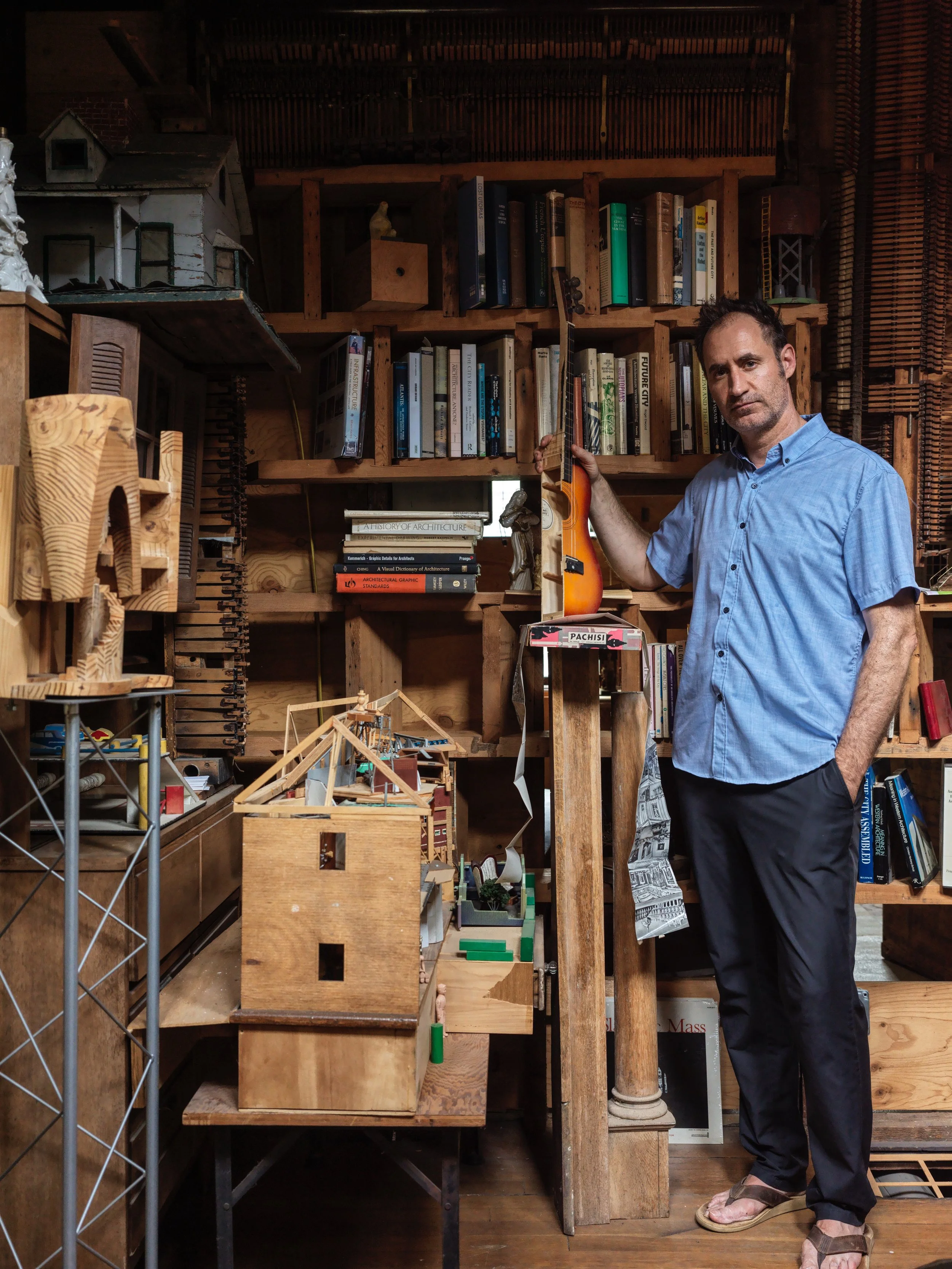
Ep. 29: Gary Hustwit
Filmmaker, photographer and perpetual entrepreneur Gary Hustwit connects the dots of his DIY-driven path through independent music, independent publishing, and independent films, to his current preoccupation with non-fiction VR. Along the way he deconstructs the methods to his madness and expounds on the popularity of his trilogy of design documentaries: Helvetica, Objectified and Urbanized. Plus he teases a bit about his forthcoming doc about Dieter Rams, and confesses that an early disdain for avocados didn’t prevent him from capitalizing on their market-appeal.
To learn more about all the awesome stuff Gary is doing, visit Hustwit.com and follow him on Instagram and Twitter. Also, check out Scenic VR.
Jaime: Since 2011, Musicbed has been changing how creatives license music. Their library is made up of more than 650 real indie musicians. From hip hop to classical compositions and everything in between, they have the perfect soundtrack for your next project. Visit musicbed.com for more.
Gary Hustwit: Hello.
Amy Devers: Hello, Gary Hustwit.
Gary: Hey, how's it going?
Amy: Good, you got Amy and Jamie here.
Jaime Derringer: Hi.
Gary: Nice to talk to you both.
Jaime: Yeah, you too.
Amy: We're excited to kind of grill you and get all the juicy details of your whole story. (Laughter)
Gary: Great. (Laughter) I'm in like the quietest place I could find, which is just my kitchen, but there's occasionally like some highway noise outside, and there's a church down the street that there will be bells, usually just on the hour, so we can predict that.
Amy: Okay, hopefully those bells will come in just at the right moment after you've said something particularly illuminating. (Laughter) Hi everyone, I'm Amy.
Jaime: I'm Jamie, and this is Clever. Today, our guest is Gary Hustwit. He's the filmmaker and director responsible for the popular design documentaries Helvetica, Objectified, and Urbanized, as well as the forthcoming Rams, a documentary about the iconic product designer Dieter Rams. He's produced a number of music documentaries, including the award-winning I'm Trying to Break Your Heart about the band Wilco.
Amy: And before all that, he made a name and businesses for himself in independent music, independent publishing, and independent DVDs. Recently, he launched ScenicVR, a Brooklyn-based content studio that focuses on non-fiction virtual reality projects. His film and photographic work has been exhibited in many museums, and he's even been named one of Fast Company's 100 most creative people in business. He's a true independent. Let's talk to Gary.
Gary: My name is Gary Hustwit. I live and work in Brooklyn, New York, and I make films, and virtual reality pieces, and photographs, and guitars, because those are all things that I'm interested in and apparently I can do.
Amy: How did you figure out you could do all that? Well, we'll get to that. That's your whole story. (Laughs) Before we get into all that, let's start at the very beginning. You and I kind of go way back. We know each other from the 90s music scene in San Diego, but it occurred to me that I don't even know if that's where you grew up. Where did you grow up
Gary: I grew up in Southern California in Orange County. I mean, I was born in Los Angeles, and then I moved down to San Diego to go to college.
Amy: So what was your childhood like and your family dynamic?
Gary: Well, my parents had moved to California, like right when they got married. They're both originally from New England. They met at the University of Rhode Island and came out in the 60s. We had one group of relatives that lived in Orange County. One of my uncles was among the original engineers who helped build Disneyland in Anaheim.
Amy: Oh, wow.
Gary: So we came out because they were in California, and my dad had got accepted to Loyola Marymount. So, California in the late 60s and early 70s, it was very different from Southern California now. (Laughs) I probably had a little bit of an unconventional childhood because I went to a school that was sort of created by my parents and some friends of theirs. They basically formed an elementary school around one of their friends who was a teacher. And so it was a private school, but it was very free form. There was a lot of literature, and language, and art, and music, kind of a one room schoolhouse. There were maybe 10 kids there when I started who were all kind of our friends. And there were probably 50 kids there when I left in sixth grade. So, it was definitely, I think, a different environment. It was super creative. And there are things that I can kind of point to specifically from that time that I'm like, yeah, and that's when I learned to that I could do this. I think it definitely influenced me a lot, just growing up in that, and saw the poetry and just the music. We had a massive backyard with gardens and animals and it was really a kind of ideal kind of place to grow up.
Amy: Would you describe the school as a place that kind of championed independent thinking or helped to foster creativity? Sometimes those types of schools, without knowing, sometimes they can just be sort of without structure and kind of chaotic. [0.05.00]
Gary: Oh yeah, no, it was very structured. (Laughs) It did champion independent thinking and divergent thinking for sure. I mean, we were sort of taught the heroes in our culture weren't sports figures or actors, but they were scientists and philosophers. I think it was, again, definitely different than most elementary schools at that point. But again, this is like early 70s California. There's a lot of new age thinking and EST and things like that happening and just kind of new philosophies. I think we were all affected by that. Also, my grandmother was also super creative and she would be constantly making me and my sisters, I have three younger sisters, be making us clothing and coming out from the East Coast and staying with us and doing crazy art projects, making robots out of tampon boxes.
Amy: I love that the women in your life got you comfortable with tampon boxes at a very young age. (Laughter)
Gary: I have a great photograph of me wearing a robot costume that was like tampon boxes, spray painted silver. (Laughter)
Amy: That is beautiful.
Gary: But she was also one of these people who, I mean, I have files of her letters that she would write to companies suggesting better ways for their products to work, or some other modification, or something they should be making. And I guess that was at the time when you could write to the president of Procter & Gamble and you'd actually get a response back from the president of the company. So she was constantly doing things like that. She had suggestions and pointers. I think in the in the 50s and 60s, she was, for a woman to be kind of doing those things was probably a little bit uncommon. I'd love to think that some of her creativity and maybe kind of design thinking kind of filtered down to me.
Amy: It sounds like it probably did. And the fact that you're impressed with her wherewithal clearly made an impact on you. Was your family dynamic very peaceful at home? Did everyone get along.
Gary: My parents split up when I was maybe 12 or 13. I'd say up to that point, it was pretty peaceful. And again, I have three younger sisters and we're all really close together in ages, so it was chaotic on that front. But in general, it was great. It was kind of idyllic Southern California thing. Our house, we had a gigantic avocado tree in our backyard, which I would be out there on the curb selling avocados. I had a little avocado stand when I was a kid, so kind of the DIY entrepreneurial streak started very young for me. At that point, we were in Garden Grove, which is, again, very close to where Disneyland is and there's a lot of Latino families. And I could sell avocados, like four for a dollar and clear 10 or 20 bucks in an afternoon. And for an eight-year-old, that was a lot of cash.
Amy: Yeah. What did you do with that cash?
Gary: I bought comic books and candy and normal stuff that an eight-year-old would buy. Skateboards. I mean, that was probably where I spent most of the money.
Amy: How did the divorce affect you?
Gary: We ended up moving around a lot. I think there was a point there from 5th grade to 10th grade where every year I was at a different school. At a certain point, me and my sisters were living with my mom and I just kind of was out of control. I was just like running around, and skateboarding with my friends, and shoplifting, and listening to Led Zeppelin and started smoking pot. And at 14, I was just basically too much for my mom to handle. So then I went and lived with my dad, who was living on the beach in Newport Beach. That was not a bad environment to be a skateboarding, music loving, surfing teenager. That's like when I really first got into surfing. It's when I first started listening to punk rock towards the end of my high school period. And this is like late 70s, early 80s.
Jaime: Do you think you were rebelling because your parents had their issues? Or do you think it was like transitioning from that very creative art focused school to like a regular school?
Gary: Maybe a little of both. But also it's like suburban Southern California. It was kind of like Newport Beach, where I then was in high school is super conservative, super white, very Republican. That's a great set of things to rebel against, and I just wasn't, I wasn't interested in school. I mean, I barely made it out of high school just because I wasn't engaged. I was much more into surfing and listening to music and hanging out with my friends. And I didn't have a lot of day-to-day structure, I guess, from my parents. [0.10.00] I just was ditching school all the time and doing that stuff.
Jaime: Were you doing anything creatively to like let it out? Were you like drawing or making music yourself or doing anything to get it out?
Gary: When I was a little younger, maybe 11, 12 years old, I spent a couple summers back in Providence in Rhode Island with our relatives there, and my uncle had a guitar shop. He was a guitar collector. He was a builder and luthier. I was like 11 and 12, he would let me just mess around in the shop and work on junky guitars and we'd go to music festivals and go on buying trips. I got into guitar around that point. I was never a natural player, but I really loved guitars. And when I was 12 and 13 years old, I would put ads in the local papers like ‘wanted old Gibson’s, Martin’s, Fender’s, cash paid.’ And people would call and they would show up at the door and there'd be like a 12-year-old kid with like $200 buying Les Paul or something.
Amy: Was that your avocado money?
Gary: That was after the avocados. (Laughter) I moved up to like buying and selling guitars when I was a kid. So I was into music and then, again, skateboarding and surfing were my big outlets. I wasn't really doing, I don't know, applied art or anything.
Amy: But soaking it up, it sounds like.
Gary: I mean surfing, when you get into it for a while, there's a huge amount of creativity and just like what you can do with a wave. And just that scene, just culturally, and just like all my friends, that was pretty much what I gravitated to. And then that led to music and into San Diego.
Amy: You had mentioned that you moved to San Diego to go to school and you barely made it through high school. What's your school story in San Diego?
Gary: I barely made it through college either. (Laughter) I didn't make it through college. Again, instantly when I got there, I just fell in with just a great group of friends, and a lot of them were in bands, and I wasn't engaged with the curriculum, and just with the with the classes.
Amy: Were you just going through the motions? Like, did you just go to college because that was what you're supposed to do?
Gary: Yeah, definitely. There was nothing at school that was engaging me at all, except for I took an electronic music class that was awesome, just playing around with modular synthesizers. But nothing at school engaged me at all. There was no music industry. I mean it's not like now where you can major in like independent records, or recording engineering, or something like that, at least at San Diego State that didn't exist in in 1980. I very quickly just kind of got kicked out on academic grounds. I just was not engaged. And then my friends were in bands. Since they were all better guitar players and better musicians than I was, I kind of started helping promote shows, or help them book a tour, or just kind of figure out how to put out a record. That's what really got me into independent music and more into the DIY culture of releasing your own records and touring with them.
Amy: You were also not just helping friends. You kind of became a manager and a promoter of bands and shows and stuff. And so you've started to make that a profession for yourself. Was there a click in your brain when you decided that you could do this for a living?
Gary: There was a point, just one specific show that I put on. It was the first real concert that I promoted where we rented out a hotel ballroom, and I booked a few of my friends’ bands, and we got the local radio station involved, and promoted it. And sure enough, hundreds of people came, and it was really fun, and everybody had a great time, and we actually made money. That was probably the moment that I realized that I could just do things for me and my friends, like things that we wanted to do and could actually be a job. Because at that time I was working like pizza delivery and bus-boying and just like all the crappy jobs that you do when you're 19 and kicked out of college. But that was way more fun. I mean, it was so fun and creative and I make posters, ad it was also right when I kind of got exposed to the Macintosh because Macintosh and laser printers had really just come out and been more widely distributed. So I could just make my own flyers, and record cover art, or whatever it was, even though I knew nothing about design. I could just go over to my friend's house and borrow his Macintosh and do it. That was the beginning of, I guess, my interest in graphic design. It was purely from a DIY standpoint of using it to make our little events that we were kind of throwing together, make them look legitimate because you can suddenly print out a beautiful looking flyer.
Amy: Yeah. Did you spiral that experience into an actual job? Because I know you worked for SST for a while.
Gary: Yeah. At some point in that period, after I'd helped a few friends release their own records, [0.15.00] I realized that there wasn't really a book that told you how to do that. And I decided to put all the notes, and addresses, and everything I'd found into a book that was called Releasing an Independent Record. And this is 1989, that's the first time I put it together. It's pre-internet. There's really, there's no way to get that information then. And I just started Xeroxing it off at Kinko's copies and just kind of putting ads in the back of like Flipside and just music magazines and stuff. And people were really into it because there's just no way to get that… you couldn't just Google what's the college radio station in Birmingham that you want to send your record to. You had to know someone who had already done it, or just make some call, try to find a record store in that city and call and see if they could tell you what were the cool clubs. But also, just things like pressing plants and just the whole process of it. So around that time, I can't even remember how I got the word that SST was hiring, but somehow, I heard it from a friend maybe and ended up getting a job at SST. And I moved back up to Orange County to work there, to do distribution. And somehow the book played a part in that. I remember showing it to Greg Ginn, or something, when I went up for my interview. I worked at SST for a couple of years doing distribution. They had been kind of burned by a couple of bigger distributors that had gone bankrupt around then, so they wanted to set up a direct distribution network. So I helped do that. And then it just got more into the kind of independent music scene. And then when I left SST, then I knew even more about all this stuff. So I did a revised version of the book and really started publishing. And then other people came to me with other indie music book ideas and people came to me with fiction and poetry. And it was all kind of the same process of just printing books and designing books, so I got more into that. That was the real start of my kind of DIY career.
Jaime: Is that how you started your book publishing company Incommunicado? It was just kind of like a DIY thing. And then it became like a real business for you?
Gary: Yeah, well, that book, Releasing an Independent Record, I mean, ended up selling like 40,000 or 50,000 copies just because there was nothing out there like it. I went through six different editions of it. And again, people came to me with other ideas. One woman who was a booking agent wanted to do a thing about booking your own tour, so we did that. And then there were so many musicians who were also writing and putting out little chapbooks of their poetry or their short stories. It seemed kind of like a natural to start publishing those things, too. Yeah, I think we probably released, I don't know, 30 or 40 different books at that point. I was still in this role of publisher. I had ‘written,’ quote unquote, a couple of books, but they still felt more like assemblages than great works of prose. I mean, I was just putting together all this information that I had and in a way that people could get it easily and use it. That was the goal. But then I just learned so much about editing and about typography. And this is when I kind of really got into fonts and just kind of figuring out how to use typefaces and get a little bit better at graphic design. But I wasn't going out to try to get design jobs. I was using it for my own projects.
Jaime: Were you doing all this by yourself or did you have people helping you?
Gary: I had people helping me, just like one full time assistant the whole time. And then if we were putting on an event or doing something, I'd bring on other people.
Amy: So at some point you moved Incommunicado from San Diego to New York. And at some point you got into making documentaries, including the Wilco documentary, I'm Trying to Break Your Heart. Can you connect the dots for us?
Gary: (Laughs) There are a lot of dots in there. (Laughter) Basically, in the late 90s, I had gotten married at that point and I split up with my wife. And that was one reason I kind of maybe didn't really want to stay in San Diego at that point. But also, I had been publishing books and we got some notoriety because I was coming out to New York and going to the different publishing trade shows. And we'd gotten some notoriety just with some of the books that we published. I just decided I'm going to move to New York and take on the publishing industry. Just kind of picked up and moved out in ‘99. And very quickly, I mean, before I even moved, I happened to go to a reading that a writer that we were working with, named Nicole Blackman, she was reading at this club that just opened called Tonic. And it was kind of a, they didn't even have a liquor license. It was very early on for them. [0.20.00] They were kind of a knitting factory-esque space. John Zorn was involved very early on. And they had a kind of area up front of the club that was just kind of an empty, I think somebody had tried to have a hair salon in there, or something like that. And I just asked the people that were running it, like, hey, what are you doing with that space? And they're like, oh, nothing, do you have something? I'm like, oh, I'm moving my book publishing company from San Diego and we need an office and maybe we can make it a store. So we started the publishing office there, but also had this kind of like late night independent press bookstore that was connected to this music venue. So all kinds of...
Amy: I remember going there with you and it was kind of amazing. Thurston Moore was curating that particular night's events.
Gary: Exactly, exactly.
Amy: I was like, what has Gary got himself into? This is rad. (Laughter)
Gary: It was it was a great time just for New York music. I had gotten so much into the literary stuff that I kind of had sort of OD'd on music a little bit. And for me, it really brought me back into loving music and getting inspired by music. That club was incredible. Thurston Moore would curate a whole month of music and films, or Will Oldham would curate a whole month of music and films. So there'd be all kinds of bands coming in and I'd be at my desk and I’d hear somebody screaming outside, I'm like, what's going on? Oh, it's Yoko Ono, she's warming up for tonight's thing with Sean Lennon. There was constantly amazing people coming through. I’d been working at SST who released Sonic Youth's records for a while, but I'd never met the band. And I got to meet Lee and Thurston and meet so many people from this scene who just kind of gel around the bookstore, would come in and want to look at books that we had been bringing in from other independent presses. Then I had all these recordings of authors who we were publishing, or their friends who would come to town and do readings. I'd started recording just spoken word, either fiction, like short stories, or poetry, or whatever, or interviews with these writers. I had kind of like a little bit of a cache of these spoken word recordings.
And this is right around where MP3 was becoming a big thing. I decided to start a website that was just kind of like a literary magazine, but in digital audio, with all these recordings. I knew other people who had recordings of writers reading their work. I just launched the site in the back of the bookstore and just gave away these recordings. And every day we'd add a new one and again, try to make it a little bit like a magazine, but in digital audio. It became hugely popular really quickly just because they were free and people were searching for MP3s. This is like the era of Napster and everything, people were searching for MP3s. We had just like a million people coming to the site in the first couple weeks. And this was also the kind of first dot com bubble and everybody was acquiring everybody else. And it was all about trying to bump up your share price. We got bought by this website, salon.com, which it's an internet magazine that still exists now, so very quickly within six months of me being there, I had launched a website and sold it, and all my publishing staff who had helped me start the website ended up coming over to Salon and being employees of Salon. That was connecting that dot.
That's right around the time when that happened is when I bought my first DVD player. I had never really been into hardcore into films. I always loved films, but I wasn't like a diehard tape swapper or something. I got hooked by DVDs and I went out and just looked around and there was nothing. There were just kind of big studio titles and just like no independent film and no independent music on DVD. I kept thinking in the back of my mind, somebody needs to start like this independent label, but for film, like it's going to have like just the SST, or the sub pop of DVDs, and just release lots of cool, cool films. And after a year, I was working at Salon, and the dotcom bubble burst, and I had to lay off all my friends and my sister who were working with me there. But I ended up at a certain point, just nobody had had done that indie label for DVD. So I left Salon and I somehow, through a friend, knew the director of DVD production at Criterion then, and I managed to convince him, this guy, Sean Anderson, to leave and to start this company with me, Plexifilm.
I didn't really know anything about how to make DVDs, but Sean did. and there were a ton of films that we wanted to put out. We started releasing and just acquiring like old films that you couldn't find, cult films or new projects. And probably within a month of us launching the company, which we launched it on September 10th, 2001, I remember that day [0.25.00] we were going to put out a press release on September 11th, like, yeah, we've opened, and we're all like geared up to. Needless to say, we didn't put the press release out for another month or so, at least. But the very first project that landed in our laps was the Wilco film, and it was just because my girlfriend at the time, her sister, was like the hugest Wilco fan ever, and was like, oh, they're making a movie about them, you guys should get involved. That project kind of spiralled out of control because the filmmakers had originally just signed up for kind of like a three week shoot of the band making the record. But all this stuff happened when the record got rejected and they left the label and all this stuff. So they needed help. The filmmakers needed help just financing the film, and just kind of producing it, and releasing it. I came on as a producer and just kind of helped them through that process.
And then we ended up putting out a ton of different films on Plexi.
Amy: But did you know anything about producing films at that point, or you're just feeling your way?
Gary: Nothing, none at all. (Laughter)
Amy: I love it, you're fearless!
Gary: Well, it just didn't seem that complex. It just seemed like putting out another project, whether it was a book, or a record, or a film. You know, you start at point A and you get to the end. It's like you make mistakes and you learn from them, and you collaborate with great people who do know, and just try to help make it happen in any way you can. And then you learn so much from going through that process once or twice, or five or six times. So we put out a bunch of films and I helped produce some other documentaries, the same kind of situation. People would come to us with projects they wanted to do or they were midway through and just needed help. And we would get involved to help them finish and release them. And maybe after four years of doing that, I just got to the point where I knew enough about documentaries that I thought I could make my own documentary.
Gary: And boy, did you!
Gary: Yeah. So that was it. Here we go, 40 minutes later. (Laughter) That's how I started to make Helvetica.
Amy: So Helvetica is your directorial debut, and it's well known within the design circles because, well, for one thing, designers were so stoked to finally have a piece of legitimate media kind of celebrating all of these unspoken energies that go into designing the world around us. But for another reason, this is one of my favorite reasons, is that it's about a font, Helvetica, which is a very sans serif kind of basic font. But in exploring Helvetica, you also created a compelling call for all of us to re-examine everything in the world around us. And then you told that story with people who were passionate about typography. And that passion comes through in such a contagious way that anybody who was maybe on the fence about watching a movie about a typeface, came out of there just like completely drinking the Kool-Aid. I mean, in the most magical way. I think we've heard enough about you to kind of understand why you might have the balls to undertake a project like this. But where did the passion come from?
Gary: Well, again, I had been interested in typography through the book publishing, and had even tried to make a couple really bad fonts in the early 90s when the programs came out that you could mash up two typefaces. And this is even pre-web when AOL had this kind of like a font swapping board and you could just upload fonts to there and people would download them. and talk about them, and stuff. I designed some really bad grunge fonts and put them on AOL's board. I still, I can walk down the street here in New York and I see one every day because the New York Sanitation Department uses it for their recycling program. Bizarre, so bizarre.
Amy: Wow! Whoa!
Gary: I still see them because they just have gotten pirated, and swapped, and copied, and used, and reused a million times. Again, I'm horrible. I'm like, I don't have any type design talent, but I wanted to try to make something cool for my book cover, so I would try to mash up fonts or Xerox stuff and mess it up and then re-scan it and bring it back in and just make interesting stuff. I read the design magazines like Emigre and these other things. I was definitely kind of a design fan. I really just wanted to watch a documentary about this stuff and there was nothing out there. And again, I already kind of had figured out the basic steps to make a documentary. I was just like, why isn't there a film about typography, or even a good film about graphic design? My background up to that point had been largely involved in music and then music documentary. That's all I really knew. [0.30.00] I kind of made that movie Helvetica like it was a music documentary, just about a font, because that's really the only way I knew how to make films. (Laughs)
Amy: And had you already begun like honing your photographic eye?
Gary: A little bit, when I moved to New York, I got into a little bit of street photography, but nothing like I do now. And I had not picked up a video camera at all. It was really starting from square one, but I could kind of see it in my head. I could see that film. I do a lot of pre-visualization, I think, that's a big part of my process is really thinking about trying to watch this movie, and hear it in my head, and just think about different possibilities. And just do I really want to watch this thing? Would this be compelling? Would I want to watch it? Once I had the idea for the film, which originally wasn't really going to be about one font, it was going to be about fonts in general, like in our environment, maybe more of an art piece where we just like saw type floating through the city and heard designers in voiceover talking about visual communication or something. It quickly kind of got polarized around Helvetica because there was like a resurgence of Helvetica then with like the Designers Republic and other people using it. And there was a lot of debate, like pro or against Helvetica. Lars Muller had come out with his little Helvetica book, the little red book. I could see a film kind of revolving around one typeface and I could use it as a vehicle to talk about all these things I wanted to talk about, about design and typography, but do it through the lens of this one font. And then also I'm in New York City. It's like I get on the subway every day and I'm surrounded by Helvetica.
At that point, I was listening to my iPod and listening to music and looking at Helvetica, and the DNA for the film just came out of my actual experiences then. Like walking around the city looking for Helvetica and then seeing a giant bus with it go by and I'm listening to El Ten Eleven, or whatever band I'm listening to on my headphones, and I really just sort of translated that to the screen.
Jaime: What I love about Helvetica is that you created this film and now people realize that they are surrounded by this font because it is everywhere. But you don't really know until you get introduced to it. And then you're like, whoa, it's all around me.
Gary: Well, there’s something that happened with that film that I didn't really realize at the time I was making it. But it's sort of a trick where it's like Where's Waldo or something. If you spend 80 minutes looking for something in the film, your brain just kind of can't stop looking for it. It's just the way our brains are programmed. We like visual puzzles. We like to try to solve these things. For me, it was just a way of getting from city to city in the film to talk to these designers, but also to show, oh, look, Helvetica is everywhere. It's in Amsterdam. It's in London, whatever. But each scene would be a word somewhere and you'd have to look for it. And oh, there it is. It says women. And then something would happen around it, and then the next scene would come. Oh, where's the word? And you just get into this groove of finding the Helvetica in every shot throughout the film. And that does something to your brain. Your brain really starts to lock into that. So when you walk out of the theater, you can't stop looking for words. So your brain has just been kind of programmed just for that little slice of time to do that. But it changes the way you look at the world. That wasn't something that I intentionally did. (Laughs) But I think it kind of subliminally really kind of set the hook in a lot of people's minds about looking for type around them.
Jaime: Did you anticipate how popular it would become?
Gary: I realized that it would be popular when I launched the website for the film, because for the first six months, I just was emailing these designers and starting to make it and shooting the interviews and everything. And then maybe six months before I plan to finish it, I put up a website for it. And I think I posted on one type geek message board that I was making a film about Helvetica with these people in it. I think that's the only press outreach I did for the entire campaign of the film. It was all just set from there. People were just dying to see a film about graphic design, and I was too. And that was the main reason that I made it. So instantly, just people went crazy and we started selling posters and T-shirts. And before the film had even come out, I think we'd sold like $75,000 worth of merchandise on the website and gotten 10,000 or 15,000 people on the mailing list. All the screening requests and all that stuff just kind of came in once I put the website up. At that point, I kind of had a hint that it would probably be okay. And then we premiered it at South by Southwest, and then it just sort of blew up after that.
Amy: I can remember from my perspective. [0.35.00] During the time that you're making Helvetica, I'm married to Kristian Dunn, who is the composer of El Ten Eleven, who is responsible for the soundtrack. I'm kind of hearing through him, hey, Gary got in touch with me, he's making a movie, he wants to use my music. And I'm like, oh, really, what's the movie about? That's cool. Gary always got his hands in something interesting. It's called Helvetica. It's about a font. And I'm like, okay. (Laughter) But then I remember just kind of having that seed tossed in the back of my brain, and it germinated, like it started to take root. And I was like I'm really interested to see this project. It's really gutsy to make a movie about a font. And Kristian's music is so cinematic, and it's sort of sweeping crescendos and stuff. I was like, wow, this is going to be epic. I was very excited.
Gary: That's great. It is epic. I mean, I don't know. It's an epic, or again, it's a rock documentary about a font. You've got its fans and its haters and it's the groupies and just everything.
Jaime: That's funny.
Gary: It's been incredible. I mean, first off, just getting to talk to all those designers who were just Massimo Vignelli, or Wim Crowell, or Michael Bierut, or Paula Scher, they're amazing, amazing, creative people. And they were so excited to finally get to talk and tell their story. But a lot of them spend a lot of time describing what design is to non-designers, whether it's clients or students. I kind of had a huge advantage because that's what they did. And they were great at it. Or Erik Spiekermann, or David Carson, they were really great at public speaking, at working an audience, at pushing people's buttons. All I had to do a lot of the time is just turn on the camera and let them go and then just figure out how to kind of chop that into something that was engaging to watch. But I had a big, big advantage because people were so talented and were known quantities within the design world. But outside of the design world, nobody had ever heard of any of them.
Amy: Did you have any issues at all with access? Were they all excited about the project and willing to engage you? It seems like they probably would be, since they'd be well aware that there wasn't a project like that out there.
Gary: Yeah, with a relatively few exceptions, everybody was super excited about it. Most of them thought I was crazy and they didn't really understand what I was doing. (Laughs) And even after we did the interviews, they still didn't understand. Even when I tried to describe to them what the film was going to be, they still didn't get it until they watched the film. And then they understood.
Amy: I don't think anybody can really get it until you watch it.
Gary: If I had to go to like a room full of investors or television programmers and try to pitch them on a feature-length documentary about a font 10 years ago, they would have laughed me out of the room. And it's so much of the time, I think with a lot of independent projects, you can see it, you can understand what it's going to be, and it's really hard to communicate that to other people before this thing exists. And that's why people use a lot of, oh, well, it's like the Godfather meets Porky's or something. (Laughter) It's always like this mashup of two different stories or something. If it's never been done before, it's hard to communicate what it's going to look like, and feel like, and the relevance of it. That was pure DIY. It was credit cards, and friends, and family, and just the T-shirt sales, and the early supporters of the film. But that's the only reason it got made. It never would have gotten made in a traditional documentary production scenario. And same with the other films, too, because after Helvetica, I got to go to a hundred cities around the world showing that film and engaging with all these incredible design communities. It was just like, okay, well, what's next? Okay, well, you know, always into gadgets and design, like furniture and stuff. But there's no film about that either. Well, Okay, well, I'll start making that. And just kept going.
Amy: It's time for a break. We'll be back with more Gary in just a minute. Support for Clever comes from Musicbed. Through a partnership with the legendary Sun Records, Musicbed's vintage collection is bringing once lost recordings to filmmakers everywhere. The collection features dozens of artists, from legends like Johnny Cash and Jerry Lee Lewis, to hidden gems like Cadillac Man from the Jesters. Right now, they're offering 20% off your next non-custom purchase. Just enter promo code Clever when you check out. [0.40.00]
Jaime: Support for Clever comes from the Frank Lloyd Wright Foundation. 2017 marks the 150th anniversary of the birth of American architect, designer, writer and educator Frank Lloyd Wright. The Frank Lloyd Wright Foundation is paying tribute with a year-long celebration of his legacy, from engaging tours at Wright's homes, Taliesin, Taliesin West, as well as public Wright sites across the country, to a limited-edition product collection. The foundation is celebrating the visionary's continued influence. Learn more about the anniversary celebration and see the full list of events at the newly launched website flw150.com. Visit frankloydwright.org for more about Frank Lloyd Wright and his legacy.
Jaime: So you followed up Helvetica with Objectified and Urbanized, so you clearly caught the director bug, and I guess the floodgates opened for you in terms of like access to people in the design world. So that was great. And now you're going to be releasing a film about Dieter Rams. Can you talk to us a little bit about what your excitement was over making a film specifically about a designer?
Gary: Yeah, because I hadn't done it yet. All my films have been these compendiums of a lot of different people kind of coming together around one idea or one subject, so this is the first time I've made a film about a single person. For me, a couple of years ago when I was talking with Mark Adams, who runs Vitsœ, who still releases Rams shelving systems and furniture designs. And I just kind of assumed that someone would already be making this film, or already have made it. And I asked him about it and he just said, no, Rams, there's no documentary. Rams doesn't want to talk about this stuff on camera. He's tired of the media. He just wants to trim his bonsai trees in his backyard and lecture occasionally or talk to students. There's a lot of times, for me, where I'll think of a project idea and if it involves someone that's in their 70s or 80s, I'm just like, oh, we got to get that person before they're gone, and get this history with design history, or music history, or whatever it is. We need to get it now because if we wait a year or two, we might lose that opportunity. So that's happened to me a lot of times in the past 10 years where I'll think of an idea for something and it'll be in my file of… I have probably 100 potential film ideas that are somewhat interesting, that I'll occasionally go back to and dig through. And there's been several that are in there where the subject ended up dying. And I was just like, oh man, I missed my chance. Nobody did it. I didn't want that to happen with Rams. I mean, that's not the only reason that I convinced him to let me make a film about him, but that's a big reason.
That maybe goes back to this idea again of once you can see something in your head and you can imagine it, you can get obsessed with it and you really need to… for me, I just need to make those things a reality. And if I know that, in some cases, like I'm the only one who could actually get the access or do it, then it's more pressure for me to be like, okay, I got to do it. But I think Rams is super fascinating just from his work, which, of course, is just phenomenal, and how those products still look and work today. But also, because he's kind of almost rejected a lot of it because he feels like he contributed to this culture of over-consumerized, unsustainable, just crap products out there. And he's a little bit remorseful about it in some ways. Like he never wanted to be a product designer. He was trained as an architect and an urban planner, and he wanted to do that. But he kind of got swept up into Braun and then he just became a product designer. I think he could have could have really done anything at that point in his life.
Amy: I can't wait to see this, I'm really excited.
Gary: He's fascinating, and obviously, there's a million people who have been influenced by him. I'm trying to not make it a flipbook of famous designers saying how great it is, but trying to dig in a little bit. It's pretty fascinating, post-World War II, Germany, kind of growing up in that environment and this sort of idea of the slate being kind of wiped clean in terms of design. And everybody's very idealistic to try to kind of, I don't know, remake Europe through architecture and design. So just all the things that are interesting about that late modernist period, Rams really has kind of embodied. Rams real passion is nature. You don't think about a Braun radio and think, oh, this guy's a nature nut and is really into like organic objects. [0.45.00] It's interesting that there's that contradiction about him, but I think he really is more like in line with, I don't know, maybe Japanese philosophy or something, but he a lot of his work to kind of create these… h, the church bell. Do you hear that?
Amy: Yeah, it's great. (Laughter)
Gary: I think it stopped. That's 3 p.m. here, like I said, it's on the hour. But a lot of Rams' work, I think to create this sort of minimal environments is so that everything else in our lives can kind of come out more. And the things that we need to sort of be in the background can be in the background, and let the outdoors, and nature, and art come to the foreground.
Amy: He's celebrating it by not competing with it.
Gary: Yeah. Just trying to reduce the visual clutter, so you can kind of focus on the things that matter to you and not just all the all the crap, the coffee maker, and the razor, and all the stuff that you might have, all these consumer products that you might have in your home. And that there's a system to it somehow. There's a consistency to it, both in the way he makes these things and designs these things, or oversaw the design of so many more products, but also in how you would live with them.
Amy: Yeah, and the relationship you would have with them needs to be uncomplicated as well.
Gary: Or not have with them. You know, there are certain things in our lives that I just want to work. I don't need to have a relationship with it, with a shelf. I just wanted to be there and be modular. And when I move houses, I can reconfigure the shelves. And I wanted to show off my books and organize my books, or whatever I'm going to put in it. I'm not thinking about the shelf itself. I'm thinking about the vase that's on the shelf, whatever.
Jaime: You have done everything from flyers to make music, to distribute music, to books and films, and sell avocados, all of this stuff.
Gary: You know what, I'll just put in one. The irony was that I hated avocados.
Amy: Oh no, no way! (Laughter)
Gary: I hated avocados when I was growing up, I thought they were disgusting. Only later when I was in college, when I was introduced to like the Carne Asada burrito at 2am, did I truly begin to appreciate guacamole.
Amy: But I also love it because that means selling avocados, it wasn't about your passion for avocados. It was that you had this entrepreneurial streak that had to express itself.
Gary: Yeah, it was my passion for comic books and skateboards. (Laughter)
Jaime: Yeah, you identified a need and a market for that need. So anyway, I was going down the road of what's next for you, which is Scenic VR, virtual reality, and that's fascinating to me. I would love to hear about how you got into that and how that came about.
Gary: I think it was almost two years ago when I started seeing the first 360 videos that were coming out. The New York Times had mailed out their Google Cardboard reader and was starting to kind of release these early nonfiction VR pieces. And yeah, I was intrigued by it both as a way to tell stories and just as a new medium, like what can we do with this as documentary filmmakers? Like how can you use VR not to create some alternate reality, but to like better describe and better tell stories about our actual reality. I went out and got a very basic 360 video rig and started shooting stuff and started getting friends that were filmmakers to try to shoot things too. And just realized that a lot of experienced documentary filmmakers weren't being asked to create in this space, so I decided to start a production company, Scenic, and get a bunch of these documentary filmmakers that I know who didn't really know anything about virtual reality, other than they were interested in finding out more, but who are fantastic storytellers, and super creative, and super smart people. I knew if I could get them engaged and kind of arm them with the gear, and hook them up with potential stories, or media outlets, or distribution and funding, that interesting things would happen. The past year, we've just been doing that. It's interesting, there are so many constraints. Like VR does something that normal flat film can't do, which is give you this sense of place and give you a sense of being there. And while it's not about this kind of rectangle anymore and what you're framing inside the rectangle, kind of the entire environment that you're in is the shot. It challenges us to try to figure out like, how do you tell a story when the viewer can look anywhere they want to look? They're not necessarily looking at what you think they should or want them to look at. It's totally up to the viewer where they want to look. I could be expecting them to look at this very important thing that's happening in front of them, but they might be looking at the ground at that moment or somewhere else. [0.50.00] It changes the way you tell stories. It changes the way you use sound as kind of a focusing device, because you can do like spatial audio where the sound's coming from a very specific direction. It's a new challenge and just a new medium, and it doesn't have any rules. It's just fun trying to kind of figure out what the visual language and the narrative language of VR can be. And the only way we do that is just experimenting and getting a lot of different ideas, and a lot of different voices, and a lot of different viewpoints, and to the creator side.
Amy: It seems to me like one of the things that appeals to you about it is that there are no rules. Am I right?
Gary: Yeah, maybe. (Laughter) Maybe that's it. When I see the stuff that's being created, it's not that I'm like, oh, I could do better than that and I'm going to do this. But part of me just thinks, oh, well, I could see something that could exist in this medium that doesn't exist yet that maybe I could help create, or maybe I could just contribute to the evolution of this as a medium. Again, it is a little bit of obsession because I want to do great work. I want to help other people do great work too. And in a medium where we're all beginners, basically, because VR, as we know it, it's the modern incarnation of it has only been around for two or three years. So it's so new. There's just so, so much to learn, and it's fun. I like trying things and making mistakes and trying to play with a new toy and see what it can do. Like, can this tell stories better than the way we've been doing it for 100 years, with this rectangle that we put flat rectangle that we project things on. I mean, in some ways, VR is a more natural medium because life is all around us. It's not just in a rectangle on the wall, or on a screen, or on your phone. And if you can create in a completely 360 immersive space, to me, it actually feels more natural than watching a movie the way we've always done it.
Amy: I can see that. It seems like kind of a tremendous responsibility as well. Do you feel the weight of that responsibility?
Gary: Um, no.
Amy: Good. (Laughter)
Gary: It's about experimentation. It's about failing. It's about trying. I feel a responsibility just to like do a lot of work and try everything I can and get as many ideas and people involved as possible, and evangelize a little bit, and to like put the VR set on my uncle at Thanksgiving dinner and like force them to watch stuff. It's really just kind of getting the word out. But I don't feel like a burden. If anything, I feel like it's liberating there because there is no precedent and there is no normal in VR. It's like whatever you want to make it right now. It's super fun. Once you've got the basic kind of tech down and have a starting point to create, I think it’s just limitless about the different directions you can go. If anything, I'm unburdened by working in VR because anything you do is new. It's all just so fun.
Amy: That's exciting.
Jaime: I want to talk about your creative process, because before when you were talking, you mentioned that you kind of visualize things before you make them. Could you tell us a little bit more about that? Do you see yourself doing that with this virtual reality stuff, too?
Gary: Yeah, I think I do that with pretty much everything, everything I do. Photography projects, or guitars, or VR, or film, or whatever. It's just trying to kind of envision what this project is going to look like.
Jaime: What does that look like? Is that you just spending a month just thinking, or going on long walks, or what is that? (Laughter)
Amy: Staring at the sky and asking for guidance.
Gary: I mean, kind of. It is a very internal process. Once I have the idea and I mean, once I'm kind of committed to it, to doing it, then it's very collaborative, but in the initial stages of just kind of ideation, it's really internal. And I'll just kind of have an idea in my head for a couple of months and just kind of keep coming back to it. And if it still engages me and still obsesses me several months after I've had the idea, or longer, then I kind of know that there's something here both for me to explore, but probably that other people will be into, too. I think going back to that first concert that I promoted in in 1987 when I'd been kicked out of college, it was just like, if you like something, there are other people out there who will like it, too. And just having the confidence in that and not trying to second guess it. For me, it's really more about is this something that I really feel needs to exist and needs to be out there and that I am just dying to see or experience? And if so, other people out there will feel that way, too. It might be 10 people. It might be 10 million people. [0.55.00] The only challenge is then sort of hooking up with all those people and letting them know. And that's what the Internet does so well. But that first stage is very internal for me. It isn't just about reading and playing music and looking at art.
Those are the ways that I get inspired, generally not watching other films or anything like that. I like when I listen to music, I generally kind of take pictures. I can hear a film before I can see it. I know that sounds so stupid and pretentious. But if I think about the Dieter Rams movie, I kind of thought about the soundtrack for it almost first before I thought about what it would be. Somehow, if you can get that blueprint in your head, for me at least, then the rest of it is easy. And the rest of it is just kind of making it. The hard part is coming up with the concept. I look at something like Helvetica. That was the hard part, coming up with the idea and having a visual kind of blueprint of the film. Making it was pretty simple. And then it just did what it was going to do once it was released. A lot of that is sort of beyond your control. But it's the concept is what you need to obsess over. If you can come up with the right concept, it sort of just makes itself, or it publicizes itself, or whatever. It'll just happen. But that initial step, I think, is really inside my head.
Amy: You come up with these concepts and then you seem to have no qualms about pursuing whatever you feel pulled to, whether that's publishing a book, or promoting a show, or deciding to produce a documentary when you've never done that before. Am I to understand that you don't have any qualms, or do you have qualms? (Laughter) And if you do, how is it that you are able to quiet them?
Gary: Oh, I got qualms.
Amy: Okay, let's talk about your qualms. No, tell me seriously, because I think so many people are plagued by second guessing themselves or doubting, especially when it's a new idea and it hasn't been proven.
Gary: It's tough because like it's the only way that I know, like I don't know any other way, because for 30 years now, this is just how I've done things. On one hand, I'm totally unemployable, like I could not work for someone else because I would just like, I think, crush any bit of creativity that I have. It's like you do it once and it works. And then you're like, oh, okay, great. Now I don't have to think about that anymore. I can just keep doing that. And it's like, look, I still have challenges raising money for projects and executing them. And a lot of times, even with Helvetica or the other films, they're not as good as the film is in my head for that project. They come up short. (Laughs)
Amy: Well, I mean, I think that's any creative could relate to that, right?
Gary: But it's being okay with that. Like, but that's also part of the project. Like, it's never going to be like that ultimate thing, just for whatever reason, for your capabilities, or your funding, or the time, or whatever it is, like you get it to the point where you can it's the best you think you can make it and then just get it out there and move on to the next the next project. So it's been a kind of a series of those things for me. Sometimes I get in a position where like, what am I going to do next? I don't know what's my next project going to be, like I don't have anything to do in next year or whatever. I try to not think about those things and just kind of know that I will have an idea between now and next year, that'll, I'm sure, keep me way too busy. I just try to just focus on finishing the things that I've already started. I think that that's my biggest problem is just too many projects that I kind of feel like they have to happen now or there's no use in doing them. I've got to, like, launch them and make them happen. It's tough when you're independent and you don't have the resources, a larger film studio or dot com or creative company would. So that for me, that's the biggest challenge is sort of like managing time and managing brain power and managing money to kind of make it all happen.
Jaime: Are there any people in your life that you've kind of looked to, to mentor you or help you or ask advice from?
Gary: There are definitely a few of the designers in the films that I've done that have done that for me from time to time. I think Massimo Vignelli was one. In general, day to day, no, there aren't any real role models. I mean, I have role models, somebody like David Lynch is a role model to me, not for the films… I mean, I love his films, but it's not like they've influenced my film work, but just the fact that you can just be kind of a totally unfiltered creative. There's no filter for him, like whatever he thinks, no matter how weird and fucked up it is, it comes out. [1:00:00] I respect that and I'm glad that we are in a world that a David Lynch can exist. And I have other friends that are painters and who kind of have that same thing just comes out, comes out on the canvas and they let it out. I respect that and I try to do that sometimes. I think I'm probably more reserved creatively than that. There haven't been real mentors. I mean, my dad early on, because he was kind of an entrepreneur as well. And I think gave me some ideas early on about how to kind of structure things in terms of like deals and the business side of it. I've been I think lucky to kind of be able to kind of do both sides of that stuff, kind of starting or running a company, but also just being able to kind of create and somehow having those two sides, hopefully somewhat equally represented.
Amy: Give us the lowdown on all your latest projects and how our listeners can find out about them or keep up with them, and your web and social media addresses so we can follow you.
Gary: hustwit.com, that's my last name, is kind of the place for the films and Rams. Scenic, our VR company has a website that watchscenic.com. You can follow me on Instagram and Twitter. Those are pretty much my main things. And I'm just like Gary underscore Hustwit and Koll Guitars. Our guitar company is KOLL, which is kollguitars.com. The Olympic City, which is the photojournalism project I've been doing for the past eight or nine years is also we've been traveling around the world, photographing former Olympic host cities and kind of documenting what remains and how they changed the city. So that's at olympiccityproject.com. I think that's about it. (Laughter)
Jaime: That's more than enough.
Amy: Thank you, Gary.
Jaime: Thanks so much.
Gary: Thanks so much for having me.
Amy: That Gary Hustwit, I don't think he ever really needed anyone to tell him what to do or where to go.
Jaime: No, certainly not.
Amy: He's always been very comfortable and invested in making his own path.
Jaime: As he was talking, I was thinking about how impressed I was with his DIY attitude. He was kind of like, you don't really know what you can do unless you try to do it. You don't really need to wait until you have all of the ducks lined up, whether it's education, or experience, or whatever. He kind of just like did what he wanted to do. And he had an idea in his head and he said that would be great. And then he just did it.
Amy: Hearing you say that, it got me thinking that so much of our conditioning is about getting our ducks in a row and dotting our T's and crossing our I's. And it's all in an effort to kind of contain uncertainty, or take as much uncertainty out of the future as possible. But Gary really seems to roll with that uncertainty. You know, like he makes it his friend. Like it's not something to be contended with as much as it's something to work with and not be afraid of. Just go forward trusting the original impulse, which is that, hey, I'd like to see this and it doesn't exist.
Jaime: Yeah, he's really good at identifying a need for something. He's like, well, I'll just fill that need.
Amy: Yeah, totally. (Laughs)
Jaime: I love it.
Amy: Totally. And then he has a super scrappy, resourceful way of doing that, which undoubtedly kind of came from that early education and that experimental school, but then got reinforced over and over again through the punk rock movement in San Diego and just making things and putting things out there according to nobody's rules. And in fact, breaking rules when you need to. Like I never could have gotten away with being kicked out of college. Never.
Jaime: No.
Amy: That would...
Jaime: I would have been in deep shit. (Laughs)
Amy: I mean, but I was also so conditioned that I never would have let myself get kicked out of college. You know what I mean?
Jaime: Yeah, I guess I was like partially scared of my parents, but also I knew that this is what I needed to do to get to where I wanted to go. And like you said, it's kind of like taking the risk out of it and just laying the groundwork for security, just because it's like based on past experiences, this is the path you need to take. But it doesn't always work out like that in real life.
Amy: I feel like I was sort of like Gary, but in school. Like I was not always performing academically and not always following the rules, but I was still soaking up all the culture and all the information and all the facilities at my disposal and learning so much. [1.05.00]
Jaime: Right. Exactly. One of the things I also really liked that he said, even though he thought it sounded pretentious, was that he hears films before he sees them.
Amy: You know, I like that too.
Jaime: I don't know. There's just something about the idea of feeling something or like he said, it's never as good as it is in the real world, right? Because in your brain, it's one thing, and then when it gets executed, there's all these constraints and all of that. But in your mind, you're unlimited in your imagination, right? And reality has constraints, so it's never going to be as good as it is in your head. But I love that in your head, you can feel things, and sense things, and set a tone for things, and then build it around those ideas, or those sounds, or the tone, or the colors, or whatever you imagine.
Amy: It's about the essence of it.
Jaime: Right. Exactly.
Amy: Anyway, I'm excited after that talk, I want to rewatch the design trilogy and I'm super excited to see Rams. And now I'll confess, I haven't really been that interested or involved with following VR. But when I hear about him talk about the storytelling challenges, it makes me very interested and excited.
Jaime: Yeah, I was thinking as he was talking, because he mentioned that like you can see everything, so the watcher might be looking at something completely different than what you want them to focus on. And throughout the history of film, it's always been this one thing, this one shot and you and the director decides, okay, this is the focal point of that shot. This is what we want people to be looking at. But that may not be the case in the future. And so I think it also gives directors and actors and everybody involved in film a huge challenge and they may have to like relearn how to create film and direct people, you know?
Amy: Absolutely. And I think it's just going to be a really dimensional form of storytelling that's going to be very exciting.
Jaime: I'm pretty stoked about it now after I talked to him and I'm thinking a little bit more about it, I think it's fascinating.
Amy: Hey, thanks for listening, everyone. Please subscribe to us on iTunes or wherever you get your podcasts and go to cleverpodcast.com to read the show notes, find out more about Gary and see images of his work.
Jaime: Connect with us on Twitter, Instagram and Facebook at Clever Podcast. We always love hearing from you guys. This episode of Clever was edited by Chris Modell of Your Studio, with music by El Ten Eleven.



Special thanks to Chris Modl of Yore Studio for editing this episode.
Music in this episode courtesy of El Ten Eleven—hear more on Bandcamp.
Shoutout to Jenny Rask for designing the Clever logo.
Keep Listening